
Abstract
This project introduces the design and deployment of a Database to Blockchain Network Conversion Tool. The tool converts traditional SQL databases into safe assets stored inside the network with the help of Hyperledger Fabric.
The project overcomes the disadvantages of traditional databases such as single points of failure, poor auditability, and data tampering risks. The system enables uploading a ".sql" database file, which will automatically be recorded as a transaction that will be stored within the ledger blocks.
The system supports secure role-based queries via a friendly user interface. The smart contracts used in the tool provide high levels of data integrity, confidentiality, as well as auditability. Although the existing implementation is based on SQL databases and on one blockchain channel usage, the blockchain network offers basic infrastructure for larger upgrades, such as multi-organization networks and advanced query modeling, and performance optimization.
Objectives
Project Scope
- Discuss how the tool is implemented with smart contracts
- Focus on permissioned blockchain (no cryptocurrency implementation)
- Only permissioned blockchains are discussed; other blockchain types are out of scope
Development Goals
- Develop a user-friendly UI tool for database uploads
- Accept SQL databases and insert each table into the permissioned blockchain network seamlessly
- Ensure smooth operation with no issues during conversion
Targeting
- Worldwide working organizations that collaborate together
- Work data is not owned by anyone but accessible to everyone authorized on the blockchain channel
- Data transparency and shared access
Methodology
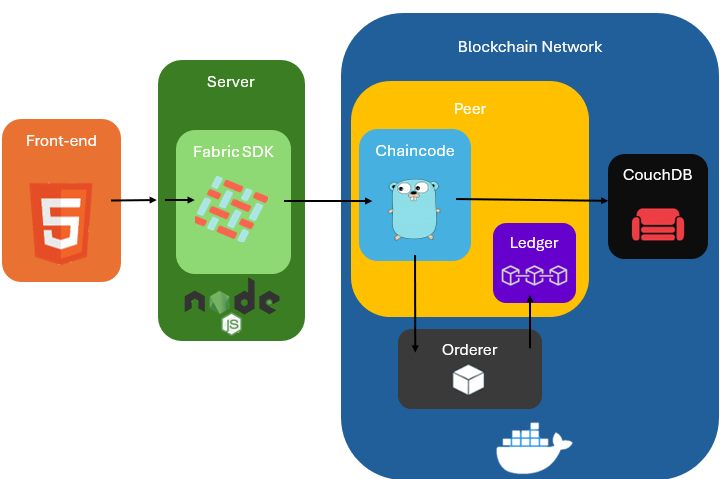
System Flow

Blockchain Network
Used Technologies
Front-end
- HTML/CSS/JS Front-end
Backend
- Backend NodeJS server
- Hyperledger Fabric Framework used inside Fabric SDK layer
Blockchain Network
- Chaincode (smart contract) written in GO
- Blockchain network componentes like orderes,peers,CouchDBs run as Docker containers
Results
The tool successfully mitigated major shortcomings in traditional database systems, especially data tampering and single points of failure, by offering a safe and transparent alternative through immutability, decentralization, and controlled access.
Key Features Delivered
- Transform database tables into protected assets inside the blockchain network
- Add new transaction blocks to the ledger
- Perform secure role-based access control
Videos
- Elevator Pitch
- Full System Implementation
Conclusion & Future Work
Key Achievements
This project successfully demonstrates how blockchain technology can enhance database security, transparency, integrity, and auditability. By converting traditional SQL databases into immutable assets in the blockchain network, the tool provides organizations with a robust foundation for secure, decentralized data management. The implementation proves the viability of Hyperledger Fabric for enterprise-grade data storage solutions.
Future Enhancements
Database Support
Expand support beyond .sql files to include NoSQL databases, CSV formats, and real-time database synchronization capabilities.
User Interface
Enhance the UI with advanced visualization tools including block explorers, transaction history timelines, and interactive data query dashboards.
Access Control
Upgrade from RBAC (Role-Based Access Control) to ABAC (Attribute-Based Access Control) for more granular and dynamic permission management.
Performance Optimization
Implement parallel processing, data sharding, and caching mechanisms to handle large-scale datasets more efficiently.
About the Project & Team
This project is a Final Year Senior Project completed during Semester 1 of the Academic Year 2025/2026 at the College of Information Technology — University of Bahrain.
Student Information
| Name | Major | ||
|---|---|---|---|
| Mohammed Jaffer | Cybersecurity | mjm.almoathen@gmail.com | |
| Hussain Ali AlAfoo | Cybersecurity | hus05ain2003@gmail.com | |
| Ibrahim Salah | Cybersecurity | ebrahsala@gmail.com |
Supervisor
| Name | Rank | |
|---|---|---|
| Dr. Ali Alsaffar | Assistant Professor | aalsaffar@uob.edu.bh |